


The Shape of Intelligence:
AI and the Changing Culture of Mathematical Knowledge
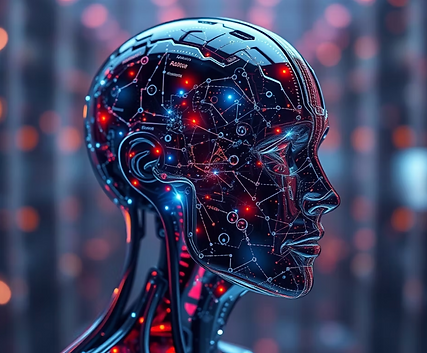
Artificial Intelligence is transforming how mathematics is done. No longer just a tool for calculation, AI now generates proofs, uncovers patterns, and proposes conjectures in ways that challenge longstanding assumptions about mathematical thought. This project investigates how AI is reshaping what counts as mathematical knowledge, the evolving role of intuition, and new forms of collaboration between humans and machines. At the heart of this work is a new vision of mathematics as a hybrid human-machine practice. As AI systems increasingly produce insights that go beyond human heuristics, they prompt us to rethink what it means to discover, to prove, and to know in mathematics. I explore how these technologies disrupt conventional ideas of creativity, authorship, agency, and responsibility in mathematical research.
Key Research Questions:
-
Can mathematical intuition remain central when AI generates insights without it?
-
What happens to the role of the mathematician when AI becomes a collaborator?
-
How do AI-generated proofs and conjectures redefine mathematical understanding?
-
What are the sociological effects of integrating AI into mathematical communities?
-
How do mathematical models in AI impact society beyond mathematics?
AI is transforming mathematics in ways that go beyond the classic “Big Science” model: it doesn’t just scale up computation and collaboration, it also shifts key epistemic work (like generating conjectures and exploring proof space) into hybrid human–machine systems. We suggest that the result is a new regime, “Big AI Mathematics,” where control over models, data, and compute concentrates authority in a few powerful hubs and makes the future of mathematical knowledge as much a governance issue as an epistemic one.


This paper asks how AI is changing what mathematical intuition means in real research. Using three case studies, it argues that AI doesn’t remove intuition; it shifts it from predicting the next step to making sense of results after the fact (through interpretation, critique, and integration), reshaping how we do mathematics in the 21st century.